Burnout is not a vague complaint: the World Health Organization formally classifies it in the ICD-11 as an occupational phenomenon resulting from chronic workplace stress that has not been successfully managed. It is not a medical diagnosis, but it is a real, well-defined pattern, and while massage cannot fix its root causes, research does show that regular bodywork meaningfully eases the physical stress that comes with it.
Is burnout actually a recognised condition?
Yes, with an important caveat. The WHO includes burn-out in the ICD-11 under the chapter for "factors influencing health status," explicitly noting it is an occupational phenomenon rather than a medical condition. It defines burnout through three characteristics: feelings of energy depletion or exhaustion, increased mental distance from one's job or growing cynicism about it, and reduced professional efficacy. The WHO is specific that the term applies to the occupational context and should not describe stress in other areas of life. For anyone working the long, deadline-driven hours common to Infopark and SmartCity, that description will likely sound familiar.
Why does Kochi's IT corridor see this pattern so often?
Infopark and SmartCity concentrate exactly the conditions research associates with occupational stress: long, irregular hours tied to global time zones, high-pressure delivery cycles, sustained screen time, and a commute along Seaport-Airport Road that eats into recovery time on either end of the day. None of these individually is unusual for tech work anywhere, but their combination, sustained over months without a real reset, is precisely the kind of chronic, unmanaged workplace stress the WHO's definition describes.
What does the research say about massage and burnout?
Here the evidence is genuinely encouraging, within limits. Multiple studies on workplace massage, including research reviewed in the Massage Therapy Journal and a systematic review published in the Journal of Occupational Health, have found that massage therapy reduces measurable markers of occupational stress such as blood pressure and cortisol, alongside self-reported improvements in mood, tension and job satisfaction. A network meta-analysis of relaxation methods for occupational stress in healthcare workers found massage therapy more effective than no intervention at reducing stress symptoms. To be precise about what this means: the research supports massage as a genuinely useful tool for managing the physical and emotional symptoms that accompany burnout, such as muscle tension, disrupted sleep and a frayed nervous system. It is not evidence that massage treats or cures burnout itself, which the WHO frames as a workplace-level problem requiring changes to workload and support, not something an individual can simply relax their way out of.
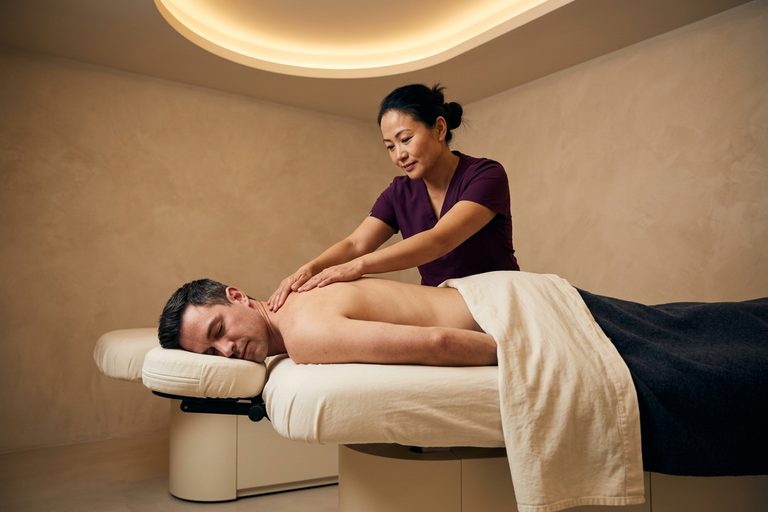
Within that honest framing, bodywork is still a genuinely useful part of a recovery routine. Our Nola Signature Massage combines several techniques into one session and suits the general, whole-body depletion burnout tends to bring, rather than one specific sore spot. For colleagues or partners going through the same stretch, a shared couple massage is a practical way to protect an hour of real rest together, rather than each person squeezing in recovery alone.
What else genuinely helps
Massage sits alongside other well-supported approaches, not in place of them. Setting real boundaries around working hours, taking full lunch breaks away from the screen, protecting sleep, and, where symptoms are serious or persistent, speaking with a doctor or counsellor all matter more than any single wellness habit. If exhaustion, cynicism and dropping performance show up together and last for weeks, that is worth taking seriously rather than waiting out.
Frequently asked questions
Is burnout the same as being stressed or tired? Not quite. The WHO defines burnout specifically as a syndrome from chronic, unmanaged workplace stress, marked by exhaustion, growing cynicism about one's job, and reduced effectiveness at work, distinct from general tiredness or a single stressful week.
Can a massage cure burnout? No, and no responsible spa should claim it can. Burnout stems from workplace conditions, and addressing it usually requires changes to workload or support at work, sometimes alongside professional help. Massage is a genuinely useful tool for easing the physical stress and tension that accompany burnout, not a treatment for its underlying cause.
How often should someone dealing with work stress get a massage? There is no fixed rule, but research on workplace stress suggests consistency matters more than intensity. Many Infopark and SmartCity professionals find a session every two to four weeks helps keep physical tension from compounding, alongside other changes to how they manage their workload.
Burnout is a real, well-documented pattern, and taking it seriously means more than one relaxing hour. At Nola Wellness Spa in Kakkanad, we offer that hour anyway, in a private room minutes from Infopark and SmartCity, open daily from 11 am to 9:30 pm. Call or WhatsApp us on +91 99955 56302 to book a session.