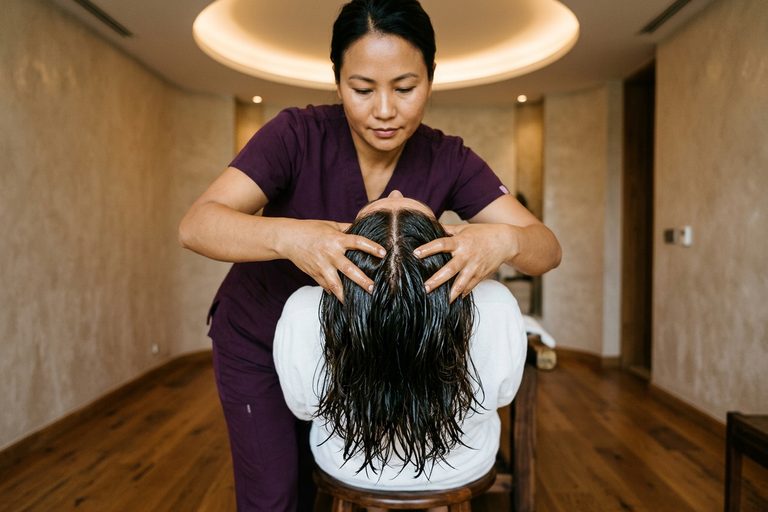
Champi is the traditional Indian head massage, a practice of kneading and circling the scalp, temples, neck and shoulders, usually with warmed oil, that dates back centuries within Ayurvedic daily life. It is also the direct origin of the English word "shampoo." The technique still works today for a straightforward reason: it targets the exact muscles, in the scalp, neck and shoulders, where screen time and desk work quietly build up tension.
What is champi, and where does the word "shampoo" come from?
Champi comes from the Hindi champi, itself rooted in the Sanskrit champana, meaning to knead or press. In Ayurvedic tradition, oiling and massaging the head was considered part of dincharya, the daily routine for maintaining health, with early references appearing in texts such as the Charaka Samhita. The practice travelled to Britain in the early 1800s through Sake Dean Mahomed, an entrepreneur born in Bengal who opened a bathhouse in Brighton offering Indian-style vapour baths and head massage. He was appointed "Shampooing Surgeon" to King George IV and later King William IV, and it was this anglicised version of champi, "shampoo," that eventually became the everyday English word for washing hair, even though the original practice was about massage rather than cleansing.
What actually happens during a champi session?
A traditional champi session begins at the shoulders, working out the tightness that feeds tension upward, before moving through the neck and into the scalp itself. Warmed oil is often worked into the hair with slow, circular kneading, though a dry version without oil is just as legitimate if you would rather head straight back to work afterwards. The temples and forehead are usually worked last and slowly, which tends to be the point most people stop noticing the time. You can see how this looks in a modern spa setting on our head massage page.
What's actually understood about its benefits?
The mechanism behind champi's effects is straightforward rather than mysterious. Many recurring tension headaches originate in the neck, jaw and scalp muscles rather than the head itself, so easing that muscle group through massage genuinely can reduce how often they occur and how intense they feel. The scalp and neck also carry a dense network of blood vessels close to the surface, and massage there supports local circulation in much the same way it does anywhere else on the body, which is part of why a good session leaves the head feeling lighter and clearer. Beyond the physical mechanism, the relaxation response itself, slower breathing, a quieter mind, lower stress, does real work too: it is one reason champi has endured for centuries as a bedtime and pre-sleep ritual in Indian households, not just a spa indulgence.
Who tends to benefit most?
Champi suits anyone whose strain sits mostly above the shoulders: long-hours screen workers, students during exam season, and anyone prone to tension headaches after a demanding day. Because it is quick and requires no undressing, it also works well for a lunch-hour reset. If your tiredness runs further down the body, pairing it with a foot reflexology session gives you relief at both ends, and for full-body tension a Swedish massage covers the rest.
Nola Wellness Spa in Kakkanad offers champi-style head massage performed the traditional way, with or without oil; call or WhatsApp +91 99955 56302 to book your session.
Frequently asked questions
Is champi the same thing as shampoo? Not exactly. Champi is the original Indian head massage; the English word "shampoo" derives from it, but came to mean hair washing over time, largely after the practice was introduced in Britain in the early 1800s.
Does head massage actually help with headaches? Many tension headaches begin in the neck, shoulders and scalp rather than the head itself, so releasing those muscles can genuinely reduce their frequency and intensity. For persistent or severe headaches, a doctor should still be consulted.
Do I need to use oil for a champi massage? No. Oil is traditional and does nourish the hair, but a dry version works the same muscles effectively, which is useful if you need to leave straight after your session.