The honest answer is mixed: the traditional claim that specific points on the foot map directly to internal organs is not well supported by rigorous scientific evidence, and major medical institutions are clear about that. What is genuinely well supported is that foot reflexology is a deeply relaxing, pressure-based therapy that can ease stress, support circulation and provide real, if modest, relief from pain and anxiety in some people.
What does traditional reflexology actually claim?
Reflexology, in its modern form, traces back to William H. Fitzgerald, an American ear, nose and throat doctor who introduced "zone therapy" in the early 20th century, proposing that pressure on specific areas of the hands and feet could influence other parts of the body. Eunice Ingham, a physiotherapist working from Fitzgerald's ideas, later extended the theory specifically to the feet, mapping the soles into zones she believed corresponded to particular organs and glands. That foot map, refined and popularised through the mid-1900s, is the version of reflexology most people encounter today, including at our foot reflexology sessions.
Does the science actually support the organ-mapping theory?
Not really, and it is worth saying so plainly. According to Cleveland Clinic, there is not strong evidence that reflexology performs any better than an ordinary foot massage, and the available research does not support the specific claim that pressing certain foot zones treats or cures conditions in corresponding organs. The U.S. National Center for Complementary and Integrative Health (NCCIH) reaches a similar conclusion: while some studies suggest reflexology may help reduce pain, anxiety and other psychological symptoms in certain groups, the underlying trials are frequently small and of mixed quality, and no systematic review has produced concrete evidence for the specific organ-zone mechanism reflexology is traditionally built around.
So what is foot reflexology actually good for?
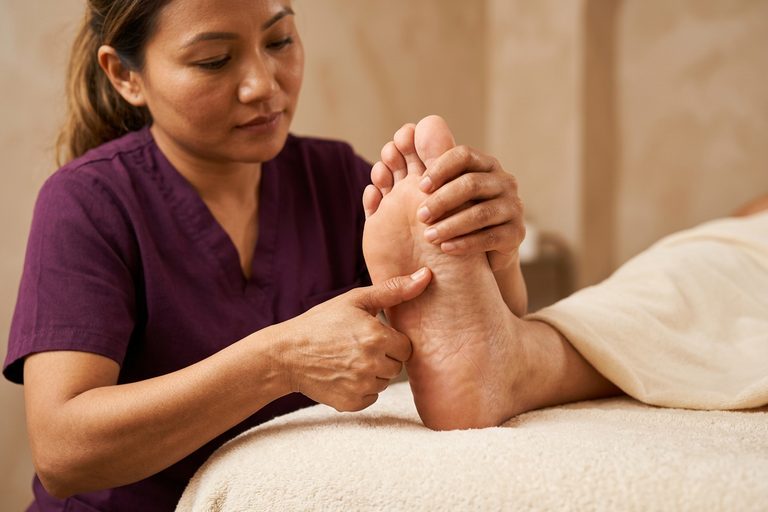
This is where the honest picture turns genuinely positive. Reflexology involves sustained, skilled pressure applied methodically across the feet, and that alone produces real, well-documented effects: it promotes relaxation, can ease general pain perception, and reliably calms the nervous system in the same way any attentive, rhythmic touch therapy does. Research summarised by NCCIH notes measurable improvements in symptoms like breathlessness in some cancer patients receiving reflexology, and other studies point to reduced anxiety before medical procedures. None of that requires the organ-map theory to be literally true; it is consistent with what is known more broadly about therapeutic touch, stress reduction and pressure-based relaxation.
Why still choose reflexology, then?
Because relaxation, better circulation and relief for tired legs are worthwhile outcomes on their own, without needing to claim more than that. A session works the soles, heels, ankles and calves systematically, addressing the genuine physical fatigue of standing or sitting all day, and it does so without undressing, which makes it one of the easiest treatments to fit into an ordinary afternoon. If you want the same pressure-point philosophy extended to the whole body, our Thai massage applies rhythmic compression more broadly, and guests recovering from a long day on their feet often pair reflexology with a head massage for relief at both ends of the body.
Nola Wellness Spa in Kakkanad offers foot reflexology described honestly, as genuine relaxation and pampering rather than a medical treatment; call or WhatsApp +91 99955 56302 to book your session.
Frequently asked questions
Is there scientific proof that foot zones correspond to organs? No. Major medical sources, including Cleveland Clinic and the NCCIH, state clearly that this specific claim is not supported by rigorous evidence, even though the practice remains widely offered as a relaxation therapy.
Is foot reflexology just a fancy foot massage, then? Largely, yes, and that is not a criticism. It is a structured, skilled, whole-foot pressure treatment that reliably relaxes the body and eases tired legs, which is a genuinely valuable outcome on its own.
Can reflexology replace medical treatment? No. It should never be used as a substitute for diagnosis or treatment from a qualified doctor, particularly for any specific health condition. It works well as a complementary relaxation therapy, not a cure.