If your eyes feel gritty and your neck feels locked by 6 pm, you are not imagining it: prolonged screen use is a recognised cause of eye strain and related muscle tension, according to the American Academy of Ophthalmology and the American Optometric Association. Massage cannot treat the eyes themselves, but a good head, scalp and neck session can meaningfully ease the muscular tightness that builds alongside it.
Is screen fatigue a real medical condition?
Yes. The American Optometric Association describes computer vision syndrome, also called digital eye strain, as a genuine group of eye and vision problems caused by prolonged use of computers, tablets and phones. The Cleveland Clinic and the American Academy of Ophthalmology both list eyestrain, headaches, blurred vision, dry eyes, and neck and shoulder pain among its common symptoms: a well-documented condition among people who spend long hours in front of screens, which describes much of Kakkanad's Infopark and SmartCity workforce.
Why does staring at a screen tighten your neck and scalp?
Two things happen at once. When you focus on a screen for long stretches, your blink rate drops noticeably, which dries and strains the eyes and signals nearby muscles to tense in response. At the same time, screens pull your head forward into what is often called "tech neck," a posture that loads the muscles at the base of the skull and along the cervical spine the longer it is held. The two problems compound each other, which is why a day of screen work so often ends in a tight scalp, a stiff neck and a headache starting at the back of the head.
Can massage actually help with this?
Here is the honest distinction: massage does not treat digital eye strain itself, and no reputable therapist should claim it does. What it does very well is release the muscular tension in the neck, shoulders and scalp that builds up around it. Research reviewed by headache organisations has found that massage targeting the neck and the trigger points at the base of the skull can reduce the frequency and intensity of tension headaches, and that improved blood flow from scalp work eases tightness that so often accompanies a long day of close focus. Loosening those muscles will not sharpen your vision, but it takes real pressure off a system working overtime.
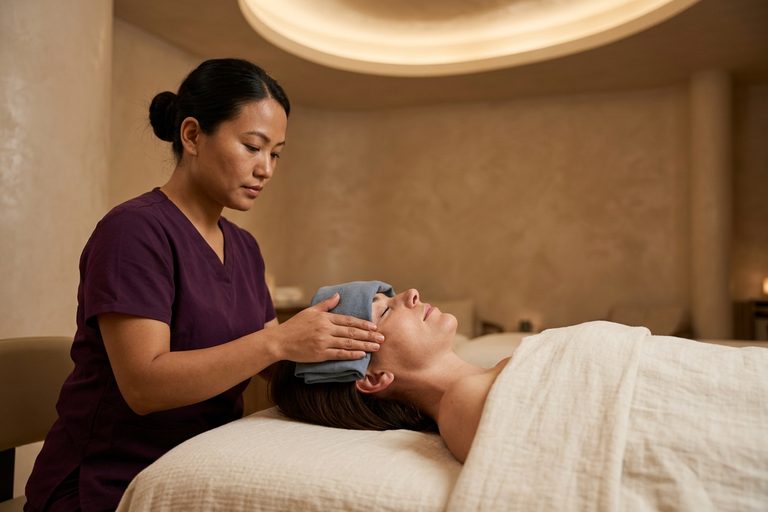
For that reason, a focused head massage is one of the most efficient sessions a screen worker can book, working through the scalp, temples, neck and shoulders in one unhurried sitting that reaches exactly the areas that tighten first. If your tension has spread into the upper back, a deep tissue massage can go deeper into the muscle layers that hold a slumped, screen-facing posture in place.
What you can do between sessions
Massage works best alongside, not instead of, basic screen habits. Ophthalmologists commonly recommend the 20-20-20 rule: every 20 minutes, look at something roughly 20 feet away for at least 20 seconds. Blinking deliberately, adjusting screen brightness, and positioning your monitor at eye level so you are not tipping your head forward all reduce the load your neck carries through the day. None of this replaces a proper reset for muscles that are already tight, but it slows how quickly they get there again.
If screen fatigue has become a daily pattern, a regular head and neck session paired with sensible screen breaks is a far better strategy than waiting until it turns into a genuine headache.
Frequently asked questions
Is digital eye strain a permanent problem? No. Eye doctors describe it as a temporary condition that improves once screen use is reduced or managed, though the discomfort can recur daily if habits do not change. It is uncomfortable rather than damaging in the long term, but it is worth addressing rather than ignoring.
Will a head massage fix my eye strain? Not directly. A head massage does not treat the eyes, but it does release the neck, scalp and shoulder tension that so often travels alongside eye strain, which is where most of the day's discomfort actually settles.
How often should desk workers get a head or neck massage? Many of our guests in the Infopark and SmartCity corridor find that a session every two to three weeks keeps tension from building back to an uncomfortable baseline, though a single visit during a particularly heavy screen week can also bring real relief.
Screen fatigue builds quietly, rarely announcing itself until the tension has settled in. At Nola Wellness Spa in Kakkanad, our head massage sessions take place in a private room, at a spa open daily from 11 am to 9:30 pm, minutes from Infopark and SmartCity. Call or WhatsApp us on +91 99955 56302 to book.