Thai massage is a traditional Thai bodywork practice that combines rhythmic compression along the body's energy lines with assisted, yoga-like stretching, performed fully clothed and without oil in its classic form. It is nicknamed "lazy person's yoga" because your therapist moves your body through the stretches while you stay completely relaxed. Research on the practice is still developing, but several studies point to real, short-term benefits for pain, flexibility and anxiety.
Where does Thai massage come from?
Traditional Thai massage, known in Thailand as Nuad Thai, traces its roots back more than 2,500 years. Its legendary founder is Shivago Komarpaj, a physician said to have lived around the time of the Buddha and to have brought early healing techniques from India into what is now Thailand. From there, the practice was preserved and developed largely within Buddhist temples, passed down orally from teacher to student for generations.
Bangkok's Wat Pho temple is often called the spiritual home of Thai massage: King Rama I had the foundational techniques carved into stone reliefs on its walls, and King Rama III later established a school of traditional medicine there. In 2019, UNESCO added Nuad Thai to its Representative List of the Intangible Cultural Heritage of Humanity, formally recognising it as a living tradition worth preserving, not simply a spa treatment.
What actually happens during a session?
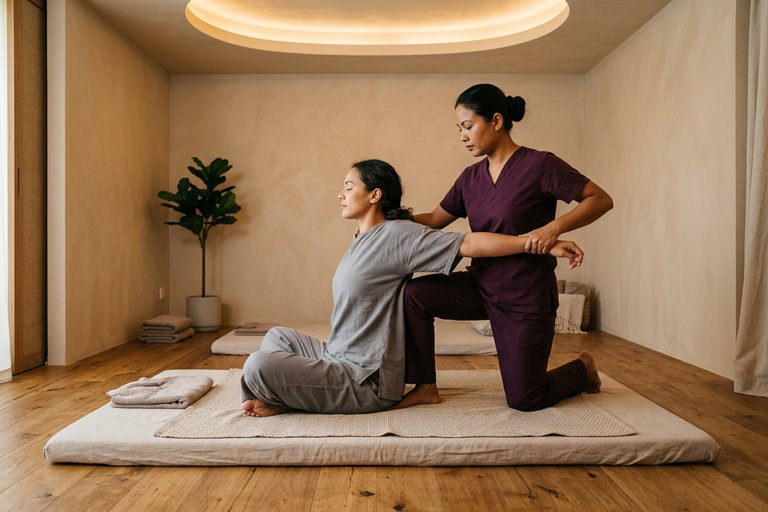
Unlike an oil massage, traditional Thai massage is performed through loose, comfortable clothing. Your therapist uses their palms, thumbs and forearms to apply rhythmic compression along the body's traditional energy lines, known as sen, warming and loosening the muscles beneath. From there, the session moves into a series of supported stretches: the hips, spine, shoulders and hamstrings are gently opened, with your therapist doing the moving and your job simply being to stay soft and let it happen. Read more about how this looks in practice on our Thai massage page.
Why is it called the "lazy person's yoga"?
The nickname captures something genuinely accurate about the technique. In a yoga class, you move your own body into each posture and hold it using your own strength. In Thai massage, your therapist guides you through comparable stretches, lengthening the same muscle groups a yoga practice would, while you contribute no effort at all. You receive much of the opening, lengthening sensation of a good stretch session without performing a single pose yourself, which is exactly what has earned it that affectionate, only slightly exaggerated title.
What does research say about its benefits?
Thai massage has drawn more scientific attention in recent years than most traditional bodywork styles, and the results so far are encouraging, if not yet conclusive. A 2015 systematic review published in Complementary Therapies in Clinical Practice, examining a body of randomised controlled trials, found that traditional Thai massage produced measurable short-term improvements in pain intensity, muscle tension, flexibility and anxiety. Other studies on patients with chronic musculoskeletal pain have reported similar reductions in discomfort and stiffness after a course of sessions.
The honest caveat is that many of the underlying studies are small, and researchers consistently call for larger, better-controlled trials before firmer conclusions can be drawn. What can be said fairly is that Thai massage has a genuine, growing evidence base behind its reputation for easing stiffness and improving range of motion, alongside the subjective calm most people report afterwards.
Who tends to benefit most?
Thai massage suits people who feel generally stiff rather than sorely knotted in one spot: long-hours desk workers, anyone whose flexibility has quietly declined, and those who find a passive stretch more appealing than an intense muscle-focused session. If your issue is more about deep, localised tension, a deep tissue massage may serve you better, and athletes recovering from training often prefer a sports massage instead.
Nola Wellness Spa in Kakkanad offers traditional Thai massage in a private, unhurried setting; call or WhatsApp +91 99955 56302 to book your session.
Frequently asked questions
Do I need to be flexible to try Thai massage? No. Your therapist works within your current range of movement and builds gradually, so stiffer bodies often notice the biggest change, not the most flexible ones.
Is Thai massage painful? It shouldn't be. The compression is firm and the stretches go deep, but a well-trained therapist stays within your comfortable range throughout and checks in as they work.
How is Thai massage different from a regular oil massage? A regular oil massage relies on gliding strokes over bare skin. Thai massage uses compression and assisted stretching through clothing, working more like guided movement therapy than a conventional rubdown.